


Car Crashes in the United States Result in High Costs. In What Areas Do These High Costs Occur?
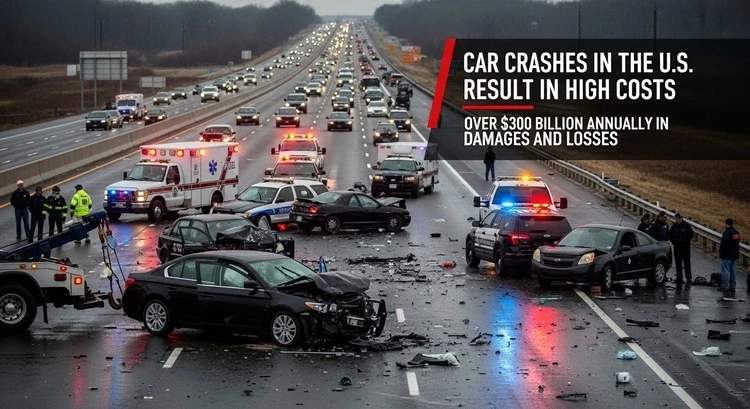
Car crashes in the United States result in high costs that primarily occur in two major areas: financial loss and human lives. When we break down these two categories, the financial burden spreads across medical treatment, vehicle repairs, lost wages, legal fees, and long-term economic disruption.
The National Highway Traffic Safety Administration (NHTSA) estimates that motor vehicle collisions cost the U.S. economy approximately $340 billion every year. However, this number only scratches the surface. When analysts factor in the loss of quality of life, the comprehensive societal cost skyrockets to $1.4 trillion annually. These numbers represent real burdens placed on individual families, local businesses, and government resources.
The Macroeconomic Impact of Motor Vehicle Collisions
Motor vehicle accidents drag down the national economy in ways that most drivers never see. Economists divide crash expenses into two distinct categories: direct economic costs and comprehensive costs.
Direct economic costs involve tangible money spent on goods and services right after an accident. This includes paying a mechanic to replace a bumper or paying a hospital for an X-ray. Comprehensive costs measure the invisible economic spillage. This includes the dollar value of a victim’s physical pain, emotional trauma, and the permanent loss of a young worker’s future contributions to the Gross Domestic Product (GDP). When a severe accident removes a skilled worker from the labor force, business productivity drops, and the entire national economy feels the ripple effect.
Direct Financial Expenditures: The Immediate Aftermath
The most visible costs hit the victim immediately. Within days of a collision, bills begin arriving in the mail. These direct expenditures form the initial financial shock of the accident, demanding rapid out-of-pocket payments before insurance claims even clear.
Emergency Healthcare and Long-Term Medical Treatment
The cost of human health is the most expensive consequence of any roadway accident. Medical billing begins the moment someone dials 911. Ambulance rides and emergency room admission fees create an instant financial hole.
For severe collisions, victims often suffer from Traumatic Brain Injuries (TBI) or spinal cord damage. These conditions require complex, multi-stage surgeries and weeks of intensive care hospitalization. Furthermore, medical spending rarely stops at discharge. Crash victims frequently require months of physical therapy and specialized rehabilitation to regain basic motor functions. Even for drivers with premium health insurance, high deductibles and specialist co-pays quickly drain emergency savings accounts.
Vehicle Repair, Property Damage, and the EV Cost Multiplier
If drivers walk away from an accident unharmed, their wallets still face the reality of the repair shop. In the past, fixing a fender bender required a simple steel replacement. Today, modern vehicles rely on Advanced Driver Assistance Systems (ADAS). A standard bumper now houses delicate parking sensors, backup cameras, and radar equipment.
The transition to Electric Vehicles (EVs) creates a massive new cost multiplier. EVs carry heavy, highly volatile lithium-ion battery packs along their undercarriages. A minor scrape that would simply dent a gas-powered car can permanently compromise an EV’s battery integrity. Because these battery packs pose severe fire risks and require expensive high-voltage technicians to repair, insurance adjusters frequently declare a $60,000 EV a total loss after minor structural damage. When faced with a totaled older vehicle, many owners bypass the expensive repair process entirely, seeking out 500 cash for junk cars without title to quickly liquidate the scrap metal and salvageable parts.
Damage to Public Infrastructure and Private Property
Vehicles spinning out of control rarely stop without hitting stationary objects. Highway crashes regularly destroy public infrastructure, including steel guardrails, utility poles, and complex traffic light systems. Replacing a single municipal street light costs thousands of dollars in materials and specialized labor.
Local governments use taxpayer funds to fix these hazards immediately to restore public safety. However, city municipalities will aggressively pursue the at-fault driver’s property damage liability insurance to recoup those funds. If the driver lacks sufficient insurance limits, the city or private property owner can sue the driver personally for the remaining balance.
Hidden and Indirect Financial Burdens
Beyond the initial shock of hospital invoices and auto body repair estimates, a massive portion of crash costs remains invisible. These indirect financial traps quietly push victims into long-term debt over months and years.
Income Disruption and the “Slow Drain” of Mild TBIs
A sudden loss of income devastates working families. When a victim recovers in a hospital bed, they stop earning paychecks. For hourly employees lacking paid sick leave, this temporary disability halts their cash flow exactly when their medical bills peak.
However, the most insidious financial drain comes from undiagnosed mild concussions. A driver might leave an accident scene feeling fine, only to develop subtle executive dysfunction weeks later. They struggle with memory retention, focus, and mood regulation. This cognitive decline leads to missed promotions, poor performance reviews, or termination. It represents a massive loss of lifetime earning potential that victims rarely manage to claim in standard insurance settlements.
The Subprime Auto Loan Trap and Negative Equity
Many financial reports ignore the trap of negative equity. When an insurance company declares a car a total loss, they pay out the vehicle’s Actual Cash Value (ACV).
This becomes a disaster for drivers who financed used cars with high-interest subprime auto loans. If a driver owes $15,000 on a loan, but the car’s depreciated ACV is only $9,000, the insurance payout leaves a $6,000 gap. The crash destroys the car, but the bank still demands immediate payment for the remaining debt. Without a vehicle to commute to work and carrying a sudden $6,000 debt, vulnerable families frequently default on their loans, triggering credit destruction that takes decades to repair.
Legal Fees, Litigation, and Administrative Costs
Proving fault on the highway requires money. Severe accidents quickly move from the asphalt to the courtroom. Hiring a personal injury attorney introduces steep contingency fees, often consuming 33% to 40% of the final settlement.
The legal process also generates heavy administrative costs. Victims pay for police report access, official medical record retrieval, and expert witness testimonies. Even when cases settle out of court, insurance companies spend billions of dollars annually maintaining massive legal defense teams and claims processing departments. Insurers eventually pass these overhead costs back to consumers through higher monthly premiums.
The Human and Societal Toll: Who Really Pays?
When two vehicles collide, the financial shockwave spreads far beyond the drivers involved. Society absorbs a massive portion of the bill. From demographic disparities to municipal budgets, the burden of highway accidents falls on people who were nowhere near the crash site.
The Gendered Injury Gap and “Crash Test Dummy” Bias
The physical and financial toll of a car crash does not fall equally on men and women. Historically, automakers designed safety features—like seatbelts, airbags, and headrests—using crash test dummies modeled after the 50th-percentile male anatomy.
Because of this deeply ingrained design bias, women are significantly more vulnerable behind the wheel. In comparable crashes, female drivers are much more likely to suffer severe injuries, such as whiplash, internal trauma, and pelvic fractures. As a result, female crash victims frequently face disproportionately higher lifetime medical costs and longer rehabilitation periods. This systemic inequality forces women to endure a steeper financial recovery path than male drivers.
Vicarious Trauma and the Cost to First Responders
Highway fatalities leave a lasting mark on the municipal workforce. Police officers, firefighters, and emergency medical technicians (EMTs) face chronic exposure to traumatic accident scenes.
This constant exposure leads to severe mental health challenges, including Post-Traumatic Stress Disorder (PTSD) among first responders. When trauma pushes public servants out of the workforce, local governments absorb the financial blow. Taxpayers ultimately foot the bill for early medical retirements, expensive workers’ compensation claims, and the high administrative costs of constantly recruiting and training new personnel to replace those who burn out.
Insurance Premium Hikes and the Taxpayer Burden
There is a common misconception that auto insurance companies pay for everything. In reality, safe drivers subsidize the mistakes of reckless ones. Insurers use zip-code premium pooling to manage risk. If you live in an area with a high volume of traffic accidents, your monthly premiums will increase, even if you maintain a flawless driving record.
Furthermore, American taxpayers absorb tens of billions of dollars in crash costs every year. When uninsured or underinsured drivers suffer catastrophic injuries, publicly funded healthcare programs like Medicaid step in to cover the hospital bills. Taxpayers also fund the municipal budgets that dispatch the police and fire crews to every accident scene.
Geographic and Environmental Variables
The location of an accident fundamentally changes the type of financial ruin a victim might experience. Geographic factors dictate everything from emergency response methods to secondary environmental damage.
The Rural vs. Urban Cost Paradox
City driving and country driving produce two entirely different economic traps. Urban areas generate high-frequency, low-severity crashes. These daily fender benders rarely cause fatalities, but their sheer volume drives up local insurance rates and clogs city courts.
Rural crashes, however, present a catastrophic financial risk. Collisions on open country roads usually involve high speeds and occur miles away from the nearest trauma center. Victims frequently require emergency helicopter transport. These “air ambulances” are notorious for out-of-network surprise billing. A single life-saving flight can leave a rural crash victim with an uninsurable, out-of-pocket medical bill ranging from $30,000 to $50,000.
Traffic Congestion and Environmental Degradation
Have you ever sat in gridlocked traffic for an hour because of a blocked intersection miles ahead? That delay operates as a silent tax on the economy. When thousands of cars grind to a halt, commercial delivery trucks miss their schedules, and hourly workers lose valuable clock-in time.
This congestion also severely harms the local environment. Thousands of idling engines burn unnecessary fuel, pumping excess carbon emissions and pollutants into the air. The NHTSA estimates that the environmental damage, wasted fuel, and lost commuter time caused by crash-related traffic jams add billions of dollars to the national tab every single year.
Strategic Interventions: Reducing the Cost of Roadway Accidents
While the financial statistics look grim, these trillions of dollars in losses are largely preventable. By attacking the root causes of human error and upgrading our infrastructure, we can drastically reduce the economic bleeding.
First, communities must prioritize strict enforcement and public education. Installing speed cameras and conducting regular sobriety checkpoints actively deters the reckless behaviors that cause the most expensive crashes. Second, civil engineers can redesign dangerous intersections by adding dedicated turn lanes, improving nighttime lighting, and installing roundabouts to naturally slow traffic flow. Finally, the automotive industry must continue standardizing advanced safety technologies. When features like automatic emergency braking and lane-keeping assist become mandatory on all new vehicles, we prevent the collision before the damage ever occurs.
Conclusion: Mitigating the Trillion-Dollar Crisis
Car crashes in the United States represent a $1.4 trillion annual crisis that quietly drains family savings, municipal budgets, and the national economy. The costs accumulate rapidly across emergency healthcare, complex vehicle repairs, lost workplace productivity, and endless legal battles. However, this is a solvable crisis. By holding reckless drivers accountable, engineering safer roads, and embracing modern vehicle technology, we can save billions of dollars and, more importantly, protect millions of human lives.
FAQs
Car crash costs primarily impact two major areas: financial resources and human lives. These broad categories break down further into specific expenses like emergency medical treatment, property damage, lost wages, and long-term quality of life reduction.
According to the National Highway Traffic Safety Administration (NHTSA), the direct economic cost of motor vehicle crashes is roughly $340 billion per year. When including the comprehensive costs of lost lives and societal harm, the total reaches approximately $1.4 trillion annually.
Yes, taxpayers absorb a massive portion of crash costs. Public funds pay for police and fire department emergency responses, infrastructure repairs to public property, and Medicaid coverage for uninsured crash victims requiring intensive hospital care.
Modern vehicles feature complex Advanced Driver Assistance Systems (ADAS). A simple bumper repair now involves replacing expensive backup cameras, radar sensors, and recalibrating digital safety systems, which requires specialized mechanics and expensive parts.